The Birth of Affordable Remote Astrophotography: How I Innovated with the Seestar S50
This is going to be fun!
I’ll never forget the feeling I had when I first viewed M42, the Orion Nebula, using my new ZWO Seestar S50 on February 8, 2024. I had unboxed it earlier that day and set it up on the driveway of my home in Miami, Florida. What emerged on my iPhone screen left me speechless.
From that day forward, I became an outspoken Seestar evangelist to my neighbors, friends, and fellow astronomers, constantly praising the power of this little marvel. How could something so small, affordable, portable, and easy to use be so capable? It quickly dawned on me that this was the beginning of a seismic shift in astronomy and astrophotography.
Unlike many who buy new astro gear and immediately face weeks of overcast weather, I was blessed with five straight nights of crystal-clear skies. But as winter turned to spring, reality set in. Clear nights became rare, and clouds and rain became the norm moving into summer. Having been spoiled by that initial streak, my frustration grew with every passing stormy evening.
That’s when I asked myself: If I could set my Seestar up somewhere else with better weather, couldn’t I enjoy my new obsession year-round?
High Costs and Cold Calls
I began researching remote observatories across the country and abroad, only to realize hosting a telescope was exorbitantly expensive—and completely out of my budget.
I called hosting facilities in New Mexico, California, and Arizona. When they asked what rig I was planning to send and I replied, “Oh, I have one of those new $500 Seestar units,” the responses were… colorful.
Facility #1: Hung up on me instantly.
Facility #2 (California):“You’re kidding, right? That thing is a toy; it’s never going to work.”
Facility #3: Quoted me $800 a month on the lower end (other quotes ranged up to $1,500/month) and added, “Why would you pay $800 a month to host a $500 scope?”
I had to agree—it made zero financial sense. I waited for the inevitable click of the receiver.
The dark clouds were now inside my head. It was far too expensive, and besides, how would I even control a Seestar remotely? Undeterred, I forged ahead. I quickly discovered you couldn’t remote-access an iPhone, Android phone, or iPad in a way that granted full operational control. I even ordered several different Android tablets off Amazon to experiment, but came up empty.
Then, while scouring YouTube for ideas, I stumbled across a video by astrophotographer Bray Falls. He was sharing his vision of launching a remote observatory accessible to regular astrophotographers—not just “Planewave dudes.” (At first, I thought he meant dudes who owned private airplanes, but a quick search revealed PlaneWave was a brand of ultra-expensive, mortgage-the-farm telescopes.)
When Bray mentioned his starting rate at Star Front Remote Observatories would be just $149 a month, I practically jumped out of my chair. It was 500% more reasonable than anything else I’d seen. Unforeseen forces were aligning to make this dream possible.
Cracking the Code
I still had one major hurdle: how to actually control the Seestar over the Internet.
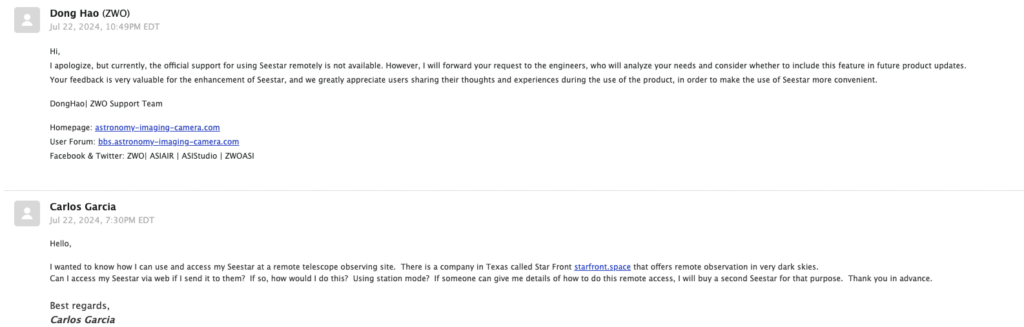
I emailed ZWO Support to ask if remote control was possible for the S50. Their response was straightforward:
I tried setting up a custom VPN based on a tip I found online, but after two weeks of troubleshooting, still no cigar.
Then, in mid-June 2024, I read an article noting that Apple’s M-series Macs could natively run iOS apps. A lightbulb went off. I had bought my wife an M1 MacBook Air a couple of years prior. I borrowed it, opened the macOS App Store, searched for the ZWO Seestar app—and there it was!
I downloaded the app and connected to my S50 right from the Mac. Then the real breakthrough hit me: software like Chrome Remote Desktop (CRD) allows you to remotely control a Mac from anywhere, including a phone.
I quickly installed CRD on the Mac and on my iPhone. To test the proof of concept, I jumped into my car and drove to a Publix parking lot a mile away. I opened CRD on my phone, accessed the Mac at home, and was instantly controlling my Seestar sitting on the back patio. Since it was 11:30 AM, I left the solar filter on and successfully imaged the Sun from a grocery store parking lot. It worked flawlessly.
When I shared the breakthrough with members of my local club, the Southern Cross Astronomical Society in Miami, reactions were mixed. “That’s crazy,” some said. “It’ll never work. You need a ‘proper’ $5,000 rig. Don’t waste your time or money.”
I knew it would work. I just needed to prove it.
Deployment to Texas
I reached out to Star Front via their Discord server. Their response was refreshing: “Sure man, send the Seestar and the Mac and we’ll hook it up just like you want.”
The next day, I ordered a brand-new Seestar and had it drop-shipped straight to Texas. Since my wife wasn’t about to let me ship her MacBook Air to a remote observatory, I ran to the local Apple Store, bought an M2 Mac Mini, set up CRD, and configured the system BIOS to automatically reboot in the event of a power outage. After verifying everything locally, I boxed up the Mac Mini and sent it on its way.
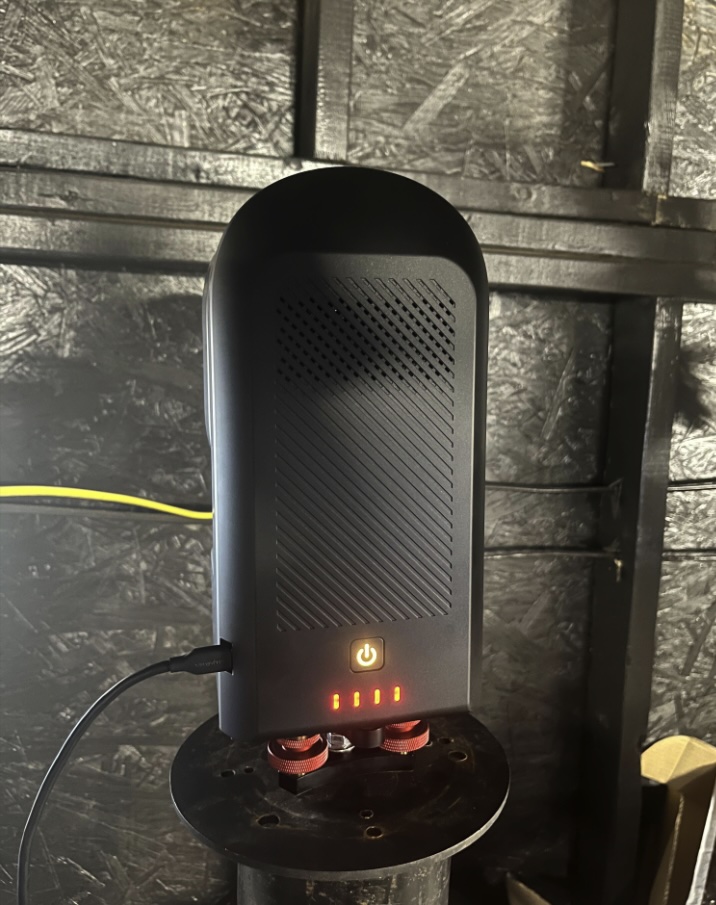
Three days after the equipment arrived, Nate from Star Front messaged me to say the system was mounted on a pier, connected to power and Wi-Fi.
first Seestar at Star Front Remote Observatories, August 2024
I logged in via CRD from my iPhone 1,500 miles away, saw the Mac desktop, and opened the Seestar app connected via Bluetooth. I couldn’t believe my eyes.
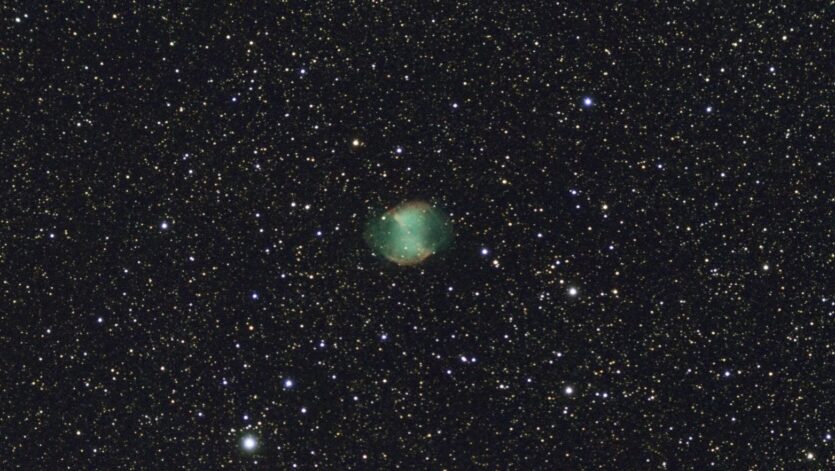
When night fell on August 22, 2024, the observatory roofs rolled back. I commanded “SS1” (Seestar 1) to target M27, the Dumbbell Nebula, under pristine Bortle 1 skies.
First capture with my Seestar at Star Front 8-2024
It was an unqualified success.
The Ripple Effect
Word spread fast across the astronomy community. The idea that you could host a $500 smart telescope at a dark-sky remote observatory caught fire.
Fast forward to today: there are over 120 Seestars and smart scopes hosted at Star Front alone. The movement grew so rapidly that top brass from ZWO—including the owner—made a special trip to Texas to see what was happening. They were blown away by how many of their devices were operating reliably under demanding remote conditions.
It’s surreal to look back at ZWO’s initial email stating remote control wasn’t possible. By incorporating a Mac Mini into the workflow, we cracked the code. Today, ZWO has even introduced a native Telescope Network feature allowing remote operation without needing a dedicated secondary computer—making remote astrophotography more accessible and efficient than ever. Bravo, ZWO!
Looking Back
Two years after installing that very first Seestar at a remote site, I am amazed by how hundreds of observers worldwide have embraced this setup. The messages and emails I receive from fellow astrophotographers are deeply gratifying.
I don’t know if I set out to start a mini-revolution, but my frustration with cloudy Miami nights forced me to improvise using the tools at hand. Necessity truly is the mother of invention—and passion was the wind in the sails.
If you’ve taken the leap into remote astrophotography with a Seestar or another smart telescope, I’d love to hear your story and learn how your experience has been! Get in touch via the contact page up top.